Sunday, July 1, 2012

Abundarchy in My Garden


bindweed covering a compost bin and rhododendron

After a day spent pulling weeds last week I thought up a new word: Abundarchy—the chaos and disorder (anarchy) resulting from abundance, as in: My garden has succumbed to abundarchy, and I allowed it to happen.

I imagine the man who planted this garden, a man who visited the local nursery every week, spry for a man in his nineties, pulling himself up and down on the ski poles he planted for balance, tugging at the plethora of weeds, wondering just when it was in the sixty years he planted and tended, that the garden got away from him. Now the garden has passed from the hands of an elderly caretaker to mine that back in January when I was settling in, treated each plant that poked above the blank wet earth as a delicate wonder.

And now the yard is overrun, not only by weeds, but by other (real) plants too, like the crocosmia bulbs that have naturalized everywhere. Oh, the abundarchy. My garden is in desperate need of a ruler, a muscled authority who is not afraid to rip out anything questionable by the roots, like my neighbor the weed warrior. 

Energetic and zealous, the weed warrior recruits volunteers to remove invasive non-native plants in local parks. She hikes with pruning shears in her pocket hacking away at holly and Himalayan blackberries. Her own garden is one hundred percent dandelion free. She leaves literature on my porch from groups like Plant Amnesty so I can eradicate any species of the region’s top ten noxious plants that exist in my half-acre yard.

By nature, I’m a plant pacifist, impressed by the tenacity and fecundity of green growing things, content, mostly, to co-exist with whatever chooses to grow in my environment. When I lived in California’s Santa Cruz Mountains a wide variety of native plants—including some rarities found only in the sandhills—I enjoyed what nature provided, planted a few gardens, and pulled only the weeds that crowded my roses or vegetable beds, or embedded themselves in shoelaces or pet fur. I also killed poison oak, and I as much as I dislike pesticides and Monsanto, I confess to using Roundup to do it, having suffered the agony of the dreaded rash several times.

I’ve lived in Washington for six months now, from winter’s solstice past summer’s, stunned to see the ground in my garden turn from dead stalks to a tangle of green—a single bed growing first tulips, then poppies, now Peruvian lilies.  After I cleared what was obviously dead, I waited, wondering what surprises this yard would yield.

Peruvian lilies

Tiny green plants emerged from the wet soil and I didn’t know what they were—planted or volunteer, welcome or weed.  My warrior neighbor warned me about buttercup and bindweed, neither one on the noxious list, but obnoxious, nonetheless.

I didn’t want to believe her. The bindweed leaves have the heart-shape and twining properties of morning glory.  Buttercup sounded sunny and sweet—like the 1968 song—a flower worthy of a bouquet.  Turns out, they are both bullies, the main culprits in the abundarchy plaguing my yard. So I am ripping them out by the roots when I can, but more often stripping leaves and stems, leaving stubborn roots in the ground to multiply, free to strangle the rhododendrons, Japanese maples, foxgloves, columbine, poppies, and other flowers and shrubs whose names I don’t know.

buttercup and bindweed choking the raspberry bed

I tell myself that next winter I will be ruthless, patrolling the garden, pulling tiny plants when the soil is moist and my battle winnable. I take photos of buttercups and other mature weeds, as if I’m taking mug shots, so I can identify them on those long dark days when they emerge tiny, young, and innocent, when the winter has dulled my memory of their ruthless qualities and I am tempted to let them live.

In the meantime, I attack the weeds in a bed here, a corner there, losing both the skirmishes and the invasion. My measly efforts, a far cry from the vigilant stance my warrior would like from me. My largesse allowing dandelions and other weedy plants to bloom, their seeds ready to scatter into nearby lawns and gardens carried by the breeze and birds.

But who am I to claim authority, to exercise dominion, to exert my will upon this landscape especially when I feel as though I’ve inherited this garden? Who could have predicted sixty and fifty and forty years ago, even thirty, twenty, and ten, how the plants would crowd each other, trees and bulbs, evergreens and perennials in such high density that they are surviving, but not thriving.

I understand editing in writing. I can slash words ruthlessly until my sentences are tighter army cot sheets, trusting that less is more. In writing I have practiced and apprenticed until I embraced my role as one who is inspired, plants, waters, weeds, harvests, and offers the bounty to others, co-creating because of the gifts entrusted by the creator.

Now I have the opportunity to edit my garden, to learn the art of revision with dirt and root, stem and leaf, to reap the fruits of that labor and to understand more about myself and these green growing things I have been entrusted to tend.
foxglove

Tuesday, June 12, 2012

If You Give a Mouse a Cookie Syndrome


I’ve been afflicted with If You Give a Mouse a Cookie syndrome. My most recent bout began with the I can’t stand this carpet any longer tear-out I blogged about last week. 

After I progressed from the outer corners of the room, I found not one, or two, but three different floor coverings under the carpet: raw plywood in a section that on the original blueprints was an observation deck, brittle green linoleum covering a portion of what was once the breakfast nook, and paint-flecked hardwood where the living room used to end.


I was prepared to live indefinitely with the plywood floor I uncovered the first day of my endeavor. I’d sand it, slather on a coat of Varathane, and move onto another project. But some of the tiles were loose (and probably made with asbestos) and the paint and spackle smearing the hardwood were unsightly.  Covering this hodgepodge became a priority, so Kevin began research. How much per square foot to use the underlayment we put on the walls in the writers suite? How much for the vinyl we’d selected for the floor?  Were there any other alternatives between those two numbers?


 My husband liked a particular brand of vinyl tiles.  He installed them in the apartment he built for his mother, easily clicking the squares in place.  So easy, I could do it, which I would probably need to do, since he’d procured a two-week consulting job. 


We went to Home Depot so I could see our options in person. Walking toward the flooring I came across a display of bamboo in our price range.  One of the cases was open.  I stroked a plank.  We bought ten cases on the spot.  Not only was it silky, it was one hundred percent wood and a renewable resource. After consulting a flooring associate, my husband determined that I’d be able to install the tongue and groove flooring, assisted by a nail gun.  


I skipped out of the store next to the cart he pushed, petting my sample square of bamboo, as if I were ten and had just been given my very own kitten. 


Poised to load the car, my husband said, “It doesn’t make any sense to install new flooring unless you paint first.” 


Paint.  First.  


That meant the ceiling, the walls, and the room divider I’d attempted to strip months earlier.  I slunk back toward the store, clutching my bamboo sample, as if to buy a litter box and claw clippers.  


I can paint.  I have been painting.  A lot. I enjoy paint’s results and forty dollars can transform an entire room. The trouble with painting is that it’s time consuming and I am lazy. 


This is how I am lazy: I learned to sew in earnest when I was twelve.  One of the first garments I made was a pair of shorts. It was 1974, and my shorts had a high fitted waistband and cuffed legs. The fabric was red and white striped with blue anchors.  


I cut the pattern, placed pieces along the straight of grain, matching seams.  I pinned the tissue to the fabric and carefully cut around notches. I used tailor’s chalk to mark rear darts and front pleats, wound my bobbin, threaded the machine, placed my fabric right sides together, sewed 5/8 inch seams, pressed multiple folds into the waistband and cuffs and steamed the front of the shorts, creating a flap to hide the zipper. 


I spent hours, days, my entire life, making those shorts, and when I cut the last threads and slipped them on, I discovered I’d sewn the zipper wrong side out.  I sucked in my stomach and pulled the zipper closed and wore those shorts for two summers, zipper head digging into my stomach, poking, itching and leaving red marks.  


I could’ve ripped it out and fixed it.  It wouldn’t have taken me more than thirty minutes.  But I was finished. 


Painting is like sewing.  So much prep work.  Stripping, sanding, caulking where surfaces meet. Washing, deglossing, spackling, priming, masking, tarping. Then there’s the actual painting: mixing, pouring without spilling, using the right brush or roller or both, cutting in, using uniform strokes, rolling evenly, dragging ladders around, climbing up and down, refilling. 


I am alternately critical and lazy when I paint. I spread color at close range, careful to saturate but not splash, and a few minutes later, a few feet away, I look back, noticing every imperfection. There are fresh drips too late to smooth, and old drips from earlier coats I hadn’t noticed before.  


I tell myself I will sand them once they dry, but rarely do. I want one coat to be enough.  It never is. I want to be done, to say I’m done, but unless I’m willing to grimace every day, like I did in my shorts, I have to pick up the brush the next day, and even the next.


During dinner a few days ago I remembered when we first looked at the house and how we envisioned opening up the wall between the kitchen and dining room, inviting conversation and expanding the view from the narrow galley out toward the garden and water. 


“Do I have to paint all the walls?” I asked, reminding Kevin of our plan. 


He considered and then knocked out the wall the next day.


Now like the mouse with a cookie, we have a whole new set of considerations: where to run wiring, where to install the cabinets he took down, what to do about the ceiling, what type of counter to install over the exposed wallboard and how to accommodate our refrigerator, which is still too large for the space we created. 

These are exciting but purely temporary distractions from painting. 

I start on my second coat tomorrow.


Tuesday, June 5, 2012

Hitting the Wall


I hit a wall Friday, psychic not sheetrock. My husband and I were hard at work trying to finish the kitchen so we could install bathroom plumbing, readying the writers’ suite for a visit in mid-June from a fellow sojourner who first encouraged me to share my passion for writing. I wanted her to experience my current vision by being my first guest in the space Kevin and I are creating.


My husband knows, or can figure out, every aspect of remodeling—calculating board cuts and window openings, using a level and terms like “on center.” He also works harder than any person I’ve ever met, and with our long days of light, puts in twelve construction hours a day, while I’ve been working about eight.


Our only excursion last week was a drive Thursday onto the Kitsap Peninsula for dinner at a brewery before we shopped Costco, Trader Joe’s, and Home Depot. I was dragging Friday. Even with ibuprofen, arnica pellets, and Traumeel cream, I couldn’t muscle my way through. My neck and shoulders have been overworked and cranky for weeks, but how could I quit? I wandered through the room feeling an inner grumbling while I vacuumed sawdust.

My mother and stepfather have been building a house for years, living first in an RV, and then in the unfinished house, while making metal sculptures to sell at craft fairs, pouring patios, and planting gardens. They work until dark, eat dinner, watch the nightly business report, then drop exhausted into bed. When I call, my mother always groans about her many chores and projects.

I don’t always have sympathy for her overwhelming self-imposed to-do-list. You’re choosing this, don’t complain is my unspoken response. So Friday when I wanted to grouse about how much work loomed in front of us, I reminded myself that I chose this house and this dream of offering a writers’ retreat, and if I was overwhelmed, it was up to me to reframe my days, the way my husband reframes windows and doors, choosing a structure and configuration that is proper and durable, not simply expedient.


I asked myself, what’s the worst that can happen if the suite isn’t finished when my good friend arrives?  She can sleep in the basement family room, on the queen bed that’s waiting to move into the writers’ room. And if the room still isn’t ready when my mother and stepfather visit in July?  Basement, again.

There was a time when I would’ve been disappointed stepping back from a deadline, even one I set myself, judging that I’d somehow failed. I’m glad my mind let go more easily now, but my body still needs to learn to lighten up and relax.

Muscle tension is lifelong for me, and even though I know I don’t need to clench my shoulder muscles to my ears when I lean from a ladder with a paintbrush, my body isn’t so sure.  Being engaged and alert kept me physically safe for years.  So how do I let go?

“Practice gratitude,” my new acupuncturist told me this morning. “This is a work in progress.  We need to find a way to help your body sustain this endeavor. When your shoulders feel tight and the work seems never ending, take a deep breath and remember that you live in a house you love and you’re creating beauty.”

“And take an Epsom salt bath, every day if you can.”

I thought about her words as I lay on the table, needles in my shoulders and legs. I pictured my run-down yet fabulous house and garden that I am bringing back to life, devoting myself to its healing, and wondered what humane work schedule might bring healing to me as well.

My husband needed our car in Seattle today, and dropped me at the clinic on his way to the ferry. On my bicycle ride home—my first on the island—I struggled up steep hills in the wind, took a wrong turn that added a mile, and peddled the edge of The Grand Forest in the rain.  Fifty-five minutes to ride what was supposed to be four and a half miles. My legs felt mushy, my heart beat loud, but I also felt energized.

I ate lunch in our dining area with carpet that smells worse the longer we live here, pet and other odors rising from thirty-year old fibers that were last steam cleaned in December.  Then, I did what I’ve wanted to do for months— not because it was a chore on a list or something to show off to friends and family—I began to rip out the carpet. 

I pried up tack bars, yanked and cut carpet, vapor barrier, and disintegrating burlap pad from the floor, one small area at a time, revealing not hardwood, as I’d hoped, but rough plywood.  I listened to Krista Tippet’s On Being podcasts while I worked.


Last week, I would’ve stopped for a quick snack and pushed on until I finished or was too exhausted to continue.  Today I worked for three or four hours.  I quit when my husband came home and left the room unusable. 

We sat in the living room and ate salami and chevre and drank Washington red wine.  Later I soaked for thirty minutes in Epsom salts, relaxing with my head underwater, pulse thudding in my ears like a marine engine, the first bath I’ve had since we’ve moved in. 

I toweled off and decided to write, for the first time in weeks. This. A day like today just might contain the components for a sustainable rhythm that honors both my body and the creative spirit.


Saturday, May 12, 2012

On Falling


The grape arbor before pruning

I fell off a ladder on Wednesday. I was pruning an old gnarly grapevine on top of a small arbor. I’ve been removing dead wood for months in my overgrown yard standing on tiptoe, waving pruning shears overhead, and it was time to tackle plants beyond my reach.

I used the aluminum ladder because it was easiest to carry. I didn’t know it had an unreliable history, collapsing on anything but the most level surface.

I unfolded it carefully, the front legs were higher than the back, but all four supports nestled in the grass. I didn’t climb higher than the third step, stretching and reaching, and realizing I was probably leaning further than was safe, I decide to move the ladder to another spot.

As I stepped down to the rung below, I felt the ladder lurch toward the asphalt driveway, and I toppled in the opposite direction, onto grass.

I hadn’t fallen in years. Oh sure, I’d tripped and stumbled and bumped and bruised, but I hadn’t tumbled through the air.

The last time I’d really crashed I was in eighth grade taking gymnastics lessons from Farouk, an Egyptian man who’d left the YMCA, where he’d broken a set of uneven bars showing off for our mothers, and was renting the gymnasium at my public school on weekends.

I was practicing a hecht. I stood on the low bar with one hand behind me on the high bar, leapt into the air, straddled, released the bar, sailed behind it, re-grasped as I brought my legs together, swung, wrapped my hips around the low bar, circling as I let go of the high bar, propelled my body tucked my legs, flew forward, and landed on the mat.

My daughter, also a gymnast,
as if she had completed the initial jump and straddle of the hecht,
and is on her way to wrap around the lower bar.

I learned the move by jumping from the ground over the low bar and working my way up the apparatus. And then, at one practice, my straddle wasn’t wide enough, one of my feet caught the high bar, I fell forward, my torso smacked against the low bar, and I crashed onto the mat.

Shaken and shocked, I felt betrayed by my body and my coach. Farouk was supposed to spot me, catch me, keep me safe. He told me to get back up and try again. I stood on the bar, trembling and could not will myself to jump, to fling myself into the air, to trust my skill, or him.

For the next month, I’d begin my bar routine, swinging and grabbing and circling until I found myself standing on the low bar, hand behind and above me, heart pounding, knees shaking, panicking I’m going to crash. Each time I balked at the hecht. I couldn’t rely my body to make the leap, or my brain––I’d grown five inches that school year––to know where I was in the air, and I’d lost confidence in Farouk.

Usually gruff and impatient, he was patient with me the first, the second, even the third aborted attempt, but after that, he shook his head, his disgust evident, told me to get down, and I skulked to the end of the line behind the other girls, bright, eager, trusting.

I didn’t know how to overcome my fear, so I quit gymnastics. Farouk tried half-heartedly to talk me out of it.


Falling off the ladder, I couldn’t have dropped far, three feet, maybe two, but it was long enough to think, Oh, I’m falling, I can’t stop it, I’m going to hit the ground, I wonder what’s going to happen. Based on my bruises, I think my arm/elbow hit first, but I felt myself thud all at once, as if I’d flopped into a low bed after running toward it.

I heard the ladder crash. I heard my husband call from our lower lot, out of sight, “Are you okay?”  I wasn’t sure. I lay on the grass, assessing. “I fell,” I called to him after who- knows-how-long a pause.

The grass was damp and cool. I could breathe, no shooting pain, but then, I hadn’t moved. I stayed in place, wondering if I could move, more curious than afraid. My knees hurt (were bruised and scraped). My elbow ached (it would develop a large hematoma).

I didn’t move until my husband came up the hill. I slowly sat up. He hadn’t seen the fall, and ever helpful, he said, “That ladder’s no good. Do you want me to get another one?” 

I shook my head no. “I’m not going back up,” I said. My brain felt fuzzy, I was muddled, tired.

Soon I’d be sore and swollen. Soon I’d wash my elbow, apply ice, fashion a sling from a scarf, try ineptly to cook dinner one-handed, and quickly pass that chore to Kevin. Soon I would wonder if I’d fractured my elbow, and the following day I’d drive myself to the local clinic for an x-ray to find I hadn’t.

But I knew even as I took my husband’s hand and slowly stood up that I would climb a ladder again, a sturdier one and soon. I know what it’s like to let fear win, and I’m done with it.
I was up on a stepstool today finishing the grape pruning. I slid a two-by-four block under the legs when the angles were unstable. Even so, I couldn’t reach very high.
pruned grape arbor with new growth.


Soon, thanks to Kevin and his Internet shopping skills, a heavy-duty sixteen-foot orchard ladder with telescoping pole will arrive at our doorstep. It weighs forty-five pounds, so I won’t be lugging it alone.

Together we will carry it into the yard and I’ll climb that ladder, but no higher than twelve-and-a-half feet, with my pruning shears in hand. I’ll finish the grape and tackle the maples and rhododendrons whose dead branches have remained out of reach for months. I’ll snip away at the dead wood and satisfied, climb carefully down.

Even if I fall I will try again and remain curious about what’s going to happen next.


Wednesday, May 2, 2012

The Marriage Feast


I am blessed to officiate a wedding for a dear friend in September.  This will be my first solo wedding and the couple has planned a lovely, simple ceremony which includes an opportunity for me to share my thoughts on marriage.  

Well before I served a church I thought sermons at weddings and funerals were awkward, too didactic and narrow to be meaningful for friends and family who are there to celebrate or honor or mourn those they love.

Talking about the ceremony on the phone tonight, I said, "I'll probably write a poem," thinking sometime in August I'd sit down to compose one.   Well, tonight, after we hung up and as soon as I finished dinner, a poem presented itself.  

It's been quite awhile since I've written a poem, and it's a delight in the midst of remodeling to create something meaningful from words instead of wood.

The Marriage Feast
For Laura and Bob

It starts with an introduction
a handshake and hello
a small kindness
that anyone would extend
to anyone else.

And then it becomes
specific, particular––
the sound of his voice
the shape of her laugh
the heart leaping
into the stomach
when the other
calls your name

And later it sticks a toe
in the water
tentative and testing
because who hasn’t been there before?
Who hasn’t placed their
fragile trust in the hands
of another
only to find it slip
and shatter
only to be left heartbroken
clutching a broom and dustpan
sweeping up pieces of themselves?

And then it dawns
the way morning colors
imperceptible but unmistakable
and you are more than okay
more than fine by yourself
more than you can contain
so you open your fist
and stretch out your fingers
intertwining them with the one
you call Beloved.


Every day together
you rise like bread
a yeast fermenting
something new between you.
And yes you are flattened
and yes you are punched down
and yes you are rolled and stretched
and shaped into someone stronger
more resilient and more expansive
more beautiful and more you
than you’ve ever been before.

And so it comes to this
right here right now
an eternal declaration to this truth.
Love is exploding all around us
showering down on you and me
shimmering like sunset on ocean
branding its image in our eyes.

Love is talking despair
down from the ledge.
Love is enfolding pain
in its embrace.
Love is looking at the world
waving its arms and shouting––
Turn off the news
pay attention to this miracle
before your very eyes.
Don’t be fooled by logic and reason
by reporters and sound bytes and bitter statistics.

Love is the thing you have to risk.
Love is the one cause worth your life.
Love is everything you can offer.
Love is going to feed the hungry world
and you are the ones to pass the platter.

With you we give thanks
with you we celebrate
with you we heap high our plates
and feast on this infinite joy.

Wednesday, April 11, 2012

Peak Experiences


Seattle & The Cascades from Bainbridge Island Ferry Terminal


I am astounded by the landscape that reveals itself in clear weather on Puget Sound.  I find myself whipping out my camera on the ferry to and from Seattle to photograph the craggy white-capped peaks of the Olympics and Cascades.  Stark and severe, even from a distance, my eye is drawn to them.
I thought I knew mountains.  For nearly a quarter century I made my home in the Santa Cruz Mountains surrounded by redwood trees.  
Our first house at the bottom of Blue Ridge Drive
Our first house was tucked at the bottom of a ridge and the sun disappeared from view mid-October to mid-March.  We counted more than a hundred trunks from our porch, but had to crane our necks to see treetops.  


View from our second house in Boulder Creek
Our second home sat in a clearing and the view encompassed a crest of green.  The weather and landscape factored large––rainstorms, mudslides, fallen trees, road closures, and downed power lines in winter; blessed shade, fairy rings, and earthy scents in summer.  We lived like fleas on the back of a dog, becoming intimate with an indifferent range.
Sunset from our second home in Boulder Creek
This island is hilly and at the tops of the hills when the sun is out, dramatic peaks emerge. I often gasp, literally, in surprise.  The mountains don’t show themselves everyday, often obscured by gray and clouds.  I am not the only person amazed by the view.  One Sunday in January as I was exiting a parking lot after church, the driver in front of me stopped at the street, jumped out of her car with her camera, snapped some pictures, waved at me idling behind her, then motored off.  I reached the stop sign, looked to the West, and saw the Olympics for the first time.  The sight of them was staggering.  I took photos, too.   

The Olympics from High School Road, Bainbridge Island

We can glimpse a few of the shorter peaks, like Mount Zion, from our community beach in good weather, and I’ve snapped their profiles.  
The Olympics from Manzanita Bay, Bainbridge Island

More than once driving to Poulsbo, the first city west of us, reachable by bridge, we’ve rounded a corner on Hwy 305 to a staggering view of Liberty Bay and a range of snowy peaks, wishing we could stop before they disappear around the next curve. 
The Olympics from Costco parking lot, Silverdale
The Cascades, in the eastern distance, extend farther on the horizon, North to Mount Baker, South to Mount Rainier.  
Mt Baker from Fay Bainbridge State Park

One achingly clear morning I took the ferry to Seattle, and as the vessel turned outside Eagle Harbor, Mount Rainier dominated my view, massive in the window.  I could only stare until the mountain disappeared behind me.
Mount Rainier from Fay Bainbridge State Park

I ask my husband––who wants to know the name and heights of the peaks we see, especially from our neighborhood, and who has placed a compass and map on our dining table––if these peaks are fascinating because they are unfamiliar, or because they’re truly spectacular.  I ask him why we didn’t research the names of the ridges that used to surround us, or carry our camera each time we left the house.  Were we jaded by familiarity?  Did we fail to pay attention?
These mountains are different, he says, the peaks are so much higher and outline so different--rocky, snow-capped.  They’re in your face.  You can’t help but notice.  He reassures me that even though it was less dramatic, we did appreciate our old panorama.  We paid attention, taking in the view from our deck on summer evenings, gazing out the window while we washed dishes.
Now we look out onto glacial summits, peaks that have captured our imaginations and contribute to the landscape we call home.
The Olympics at Sunset on Manzanita Bay


Monday, March 26, 2012

Further Than I Can See


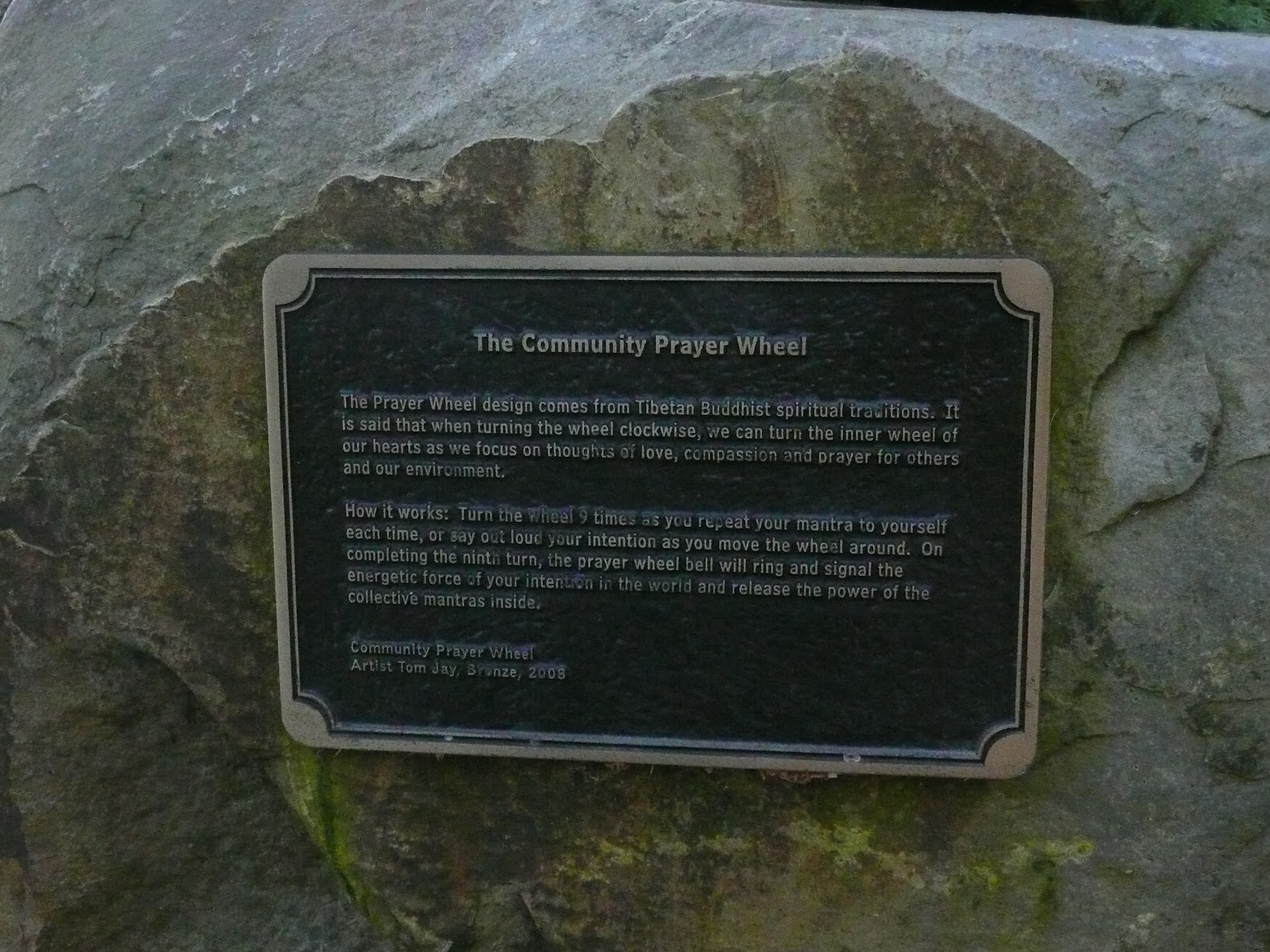
I was playing tour guide, driving my first non-family visitor––my prayer partner of 15 plus years––on a scenic tour of my new environs, skirting the edges of the island, headed from one Sound view to the next when we passed a wooden sign on a lonely road, “Hall’s Hill Overlook, In Memory of Noel Burk.”  I pulled over and parked. We followed a path from the road into a garden, over a footbridge and a small pond, and happened upon a spectacular cast bronze Tibetan prayer wheel depicting the plants, animals, birds, and marine life here on Bainbridge Island. 

Providence––a prayer park presenting itself on this small sojourn, another fitting and precious gift on the spiritual journey my friend and I have walked together since our children were young.  Our hands touched the wheel, taking in intricacies as we slowly turned it, read the inscriptions, and were amazed when a chime, deep and resonant filled the crisp air.  Then we saw the instructions for this “Community Prayer Wheel” and followed them, lifting up our intentions as we spun the wheel in silence nine times until the bell’s toll released the mantras of the community. 


For three years my prayer partner and her family lived in England, back before Skype and Facebook, and our emails were infrequent.  I missed her, but I knew she’d come home and we reconnected easily, filling each other in on the details of life we’d missed.  We may never live near each other again, so we are learning how to stay in community from afar.  Instead of long walks, tea by the fire, and holding hands as we sit side-by-side on a couch, we are praying on the phone, scheduling two or three hour calls, talking with headsets while we sort laundry, wash dishes, pull weeds, then settling down, usually with a cat on our laps, eyes closed, breathing deeply, hearing static in the airwaves as we keep silence, trusting that we haven’t been disconnected, speaking the Lord’s Prayer not quite in unison, so that we can each hear the other. 
That beautiful afternoon I twirled the prayer wheel and read its inscriptions while my friend videotaped.  “Faith is the daring of the soul to go further than it can see.” 
I relish the truth of those words.  We are always living out of faith even when we don’t recognize it.  As L Frank Baum wrote, “No one knows what’s going to happen next.”  I had grown familiar with so much of my life in California that I thought I could see my future clearly.  Then, like a snow globe, life shook up and the view was obscured.  And in the limited visibility, possibility opened in a way that previous clarity had stifled. 
As I become accustomed to life on this island, it’s tempting to think I can see what’s ahead and plan for it––like the bell on the prayer wheel.  I’ve taken two other visiting friends to Hall’s Hill Overlook, and each time I was startled by the lovely peal.  My spirit leapt as the unleashed prayers vibrated in the chill light reminding me that every day is a daring adventure of faith.