Tuesday, July 21, 2015

Got To Keep On Moving


 Transitions abound for my husband and me. We rent a moving truck tomorrow.


After 15 months of renting a house with an amazing view of the Seattle skyline and Puget Sound (and fireworks displays lasting two hours on July 4th), we are homeowners (home borrowers) once again.

Fireworks from the deck of our rental

Little did we know when me moved into our rental that the freshly shampooed carpets were a bandaid  for a home that reeked of pet urine and was unlivable. We begged, wheedled and played let's make a deal with our landlords to replace the carpets--ripping them out and doing all the odor sealing work ourselves. We leave behind a near complete flip, a house painted inside and out, the vast majority of improvements done at our own expense, having paid for the "privilege" of doing so.

Although we have done what's right for the house, it's not the right thing for our pocketbooks. This is why we are terrible renters. Lesson learned.


One of Seattle's many moods, seen from the deck of our rental

We have already begun fixing our new fixer-upper, painting the inside and ripping out those urine soaked carpets (what's the story pet owners? I've had animals all my life, and know they are precious members of the family, yet I never allowed them to ruin my home) and painting the bedroom floors for our temporary fix before we begin remodeling and permanent renovations over the next year or so.

At our new house the deck is sanded and ready for relaxing!


Look closely and you can see Mt. Rainier from my new house!

Our gorgeous waterfront project house is under contract, and received kudos from the County inspector who issued our final permit and certificate of occupancy. Yesterday, the buyer's agent informed us the house also received the best inspection report ever issued from the region's most notoriously harsh home inspector; a dubious honor, but an honor nonetheless.

The realtors who toured the home were universally impressed with our design and material choices—all done by our youngest daughter who is entering her last year of architecture school. A bright future awaits!

We're just waiting for the buyers to obtain their financing and then our dream home will become theirs.

The end of our dream, the beginning of someone else's

As if there's not enough moving and packing and painting and mental gymnastics going on in our heads trying to keep all the activities ordered and executed, we have an offer in on another project house to renovate and sell (without living in it). We spotted the house a few months back; the price dropped and now there are multiple offers. We'll see what unfolds.


A man prays inside St. James Cathedral


In the midst of all this, I spent a day in Seattle a few weeks ago, and wrote an essay about my experience at the Cathedral there and my own attempts to live faithfully outside of a faith community.
You can read that story here.


Nobody's gonna break our stride...got to keep on moving!

The winding road to the future!

Wednesday, May 27, 2015

Live-In Renovating, or Why It's a Project House

My husband and I are in negotiations to buy our next live-in renovation. When I shared the news on Facebook my friend Laura asked, “Curious why it’s a project house, it looks great as is.”

She’s right: the house has character and curb appeal, and the photo I shared captures those aspects and not the peeling paint or broken doors.

The photo I posted on Facebook


Curb appeal photo


living room with hardwood floor and view of Henderson Bay


I can answer Laura’s question by saying what needs to be fixed: exterior paint, garage door and roof, the 1970’s green pet-ruined carpets, weather-beaten and dog scratched deck; but that list, isn’t a renovation.
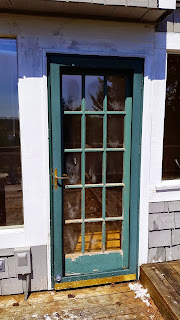
Weatherbeaten exterior paint and deck

Beat up deck but great landscaping

To say why this is a project house, I want to explain what I’ve learned about the difference between buying a home with the idea of living in it long term and buying it with the idea of resale in a few years.

My husband and I have owned three homes in our 32 years of marriage. The first was constructed as a vacation cabin in the 1930s, and added on to once or twice before it became ours. We moved into an 800 square-foot home with 3 small bedrooms and 1 bath, without a garage or carport or landscaping, and a woodstove as the only heat source.

Over the course of 13 years, we built a backyard deck and a studio/playhouse, installed central heat, remodeled to add a master bedroom and bath in a daylight basement, knocked out walls to make a dining room upstairs, replaced the kitchen cabinets with maple ones my stepfather built, installed new flooring in every room, and put a new tub and toilet in the existing bathroom, in addition to septic repairs and regular maintenance.

We did all this a little at a time to accommodate our growing family, and financed the improvements with bonuses, stock options, and salary increases my husband received in the corporate world.

We sold the house for significantly more than we paid, and even including the costs of materials and labor over the years, came out ahead. That experience mirrored what I’d heard growing up as part of the American dream: owning a home is always a good investment.

We built our next house, buying a 7 acre parcel of unimproved land and literally sinking thousands of dollars into the ground as we built a non-standard septic system to work in sandy soil, ran water, natural gas, and electricity, graded for a driveway and foundation, and installed an engineered fence to hold back a rock terraced hillside built in the 1880s (you can read my essay about the stone walls here).

The stock market was booming then, so we loaded our home with all the modern conveniences—stereo speakers in every room, custom closets and dressers, roll-out desks, bookcases, china cabinets, window seats, and a Murphy bed.

We built our dream home on a dream lot, following the advice of the property’s listing broker to build a house worthy of the property.

The trouble was, unlike places such as Saratoga and Los Gatos in the Santa Cruz Mountains, Boulder Creek is not an area associated with luxury, and when it came time to sell after my husband was laid off, we found ourselves, like so many others, parting with our house for much less than we paid for it.

Paying cash for the land and many of the improvements so that our mortgage was manageable saved us from a “short sale” and bank involvement.

We bought our Bainbridge Island house just as we signed a sale contract for our Boulder Creek dream home. Without a job to qualify for a mortgage, we were cash buyers looking for a low-priced house that also had amenities important to us: space for an apartment retreat I could rent out, nice yard, and water view if possible.

I’ve written in detail about that journey on this blog before, and the condensed story, is that when we sold our home after two-and-a-half years, we’d renovated it from studs to ceiling.

We came out ahead on the sale for two important reasons: First, we did almost all the work ourselves, only hiring help in the very last months. Second, the home was our primary residence for longer than two years, allowing us to avoid capital gains taxes.

Now that renovating homes is our livelihood, resale potential becomes a primary factor. Buying a house already in great shape isn’t a wise choice, since there’s no real value we can add.

Buying a dilapidated home doesn’t work either; not only can’t we live in the home while working on it, but it’s a bad investment. When there’s too much work to be done, there’s no way to make a profit. This is why you see derelict homes with “For Sale” signs for years, until finally, the building is razed for new development or burned as practice by firefighters. There’s just no way to make the needed repairs pay for themselves.

Real estate investors who do traditional “flips” typically fix and update: replacing broken windows, musty carpets, appliances, toilets, and vanities, but they avoid upgrading plumbing or electrical, remodeling, or re-roofing.

Any work that requires a permit costs rehabbers valuable time and money, so “the numbers” have to work, meaning a formula that weighs purchase price, “holding” and improvement costs, and future selling costs, against future sales price must yield a profit, typically 20-30%.

That’s where people like my husband and I come in, taking risks on major repairs because we envision potential in the property, the view, the neighborhood, community, or something else that spurs us to sink (hundreds of) thousands of dollars into a house that can only be recouped by the financial benefits of living in it for at least two years.

The home we’re planning to buy has a ground floor apartment, great landscaping, views of Henderson Bay and Mount Rainier, and sits on a picturesque street that will soon be widened, connected to another road, and utilities placed underground. All of those are great assets we want to capitalize on.

Ground floor apartment, main level living, upper level bedrooms


Rhododendrons & Japanese maple, part of the lovely landscaping

Henderson Bay from deck

Mt Rainier behind the treetops

Besides the obvious repairs mentioned earlier, drawbacks include a mid-house staircase that negatively impacts the apartment kitchen, the main floor living area, kitchen, and bath. And the master bedroom ceiling slopes quite low at the windows, blocking the views.


We envision eliminating the interior stairs and moving some walls, and raising the roof in the master bedroom with the possible addition of a rooftop deck for unobstructed views of Mt. Rainier and Henderson Bay if the costs are reasonable. We believe the transformation will be worth our time and money. And, that’s why it’s a project house.

In the meantime, we've discovered the garage was built partially on neighboring property, which means lots of research now to determine if we want to go through with the purchase and future legal costs.

The cute but problematic garage

Monday, May 25, 2015

Poetry Inspired Art Part 2

I am fortunate this year to have all three poems I submitted for "Ars Poetica" selected for interpretation by local artists. I wrote about my experience last Sunday with my poem "Magnum Opus," in this blog. 

This Sunday, I had the privilege of seeing two works of art inspired by my poetry displayed on the walls of the Creative Visions Gallery in Bremerton, and to speak with the two artists after the program.

Faye Bainbridge Park on Bainbridge Island was one of my first discoveries a few weeks after moving to Washington, and I made sure that I took visiting friends and family there. It's on the east side of the Island facing into the deep water passage of Puget Sound (a location where it's easy to spot the Orcas when they travel past). 

Bill Walcott, the painter who chose my poem, had never been there, so he made a trip on a gloriously clear day, took numerous photos, and then over several months created an incredibly detailed painting. His panorama is much larger than a camera can capture (unless you can successfully use panorama mode, which I never can), and there's a warmth and intimacy I don't find even in my loveliest photos of the park. And, the frame is a perfect weathered wood accompaniment, ordered specially for the piece after it was done. 

Bill works in acrylic and is well known locally for his realism and attention to detail. Looking at his painting, it captured everything about the park that makes it so alluring. I think you'll agree. (In a side note, he sold the work!)


At Faye Bainbridge Park by Bill Walcott, acrylic


Here's my poem:


At Fay Bainbridge Park

I pick my way along the trunks of trees
bleached like bones and strewn upon the beach.
Jumping from one relic to the next
I forge a wooden path over rocks and seaweed
and think what it took to topple these
once proud and stately firs, cedars, elms.

What forces must have cleaved them
from familiar earth, uprooted them from home
and swept them into the sea rolling and pitching
on the churning water, until one day—
who knows how many months or years later—
a king tide delivered them
tempest tossed and waterlogged
to the safety of this shore.

And I wonder how long they will stay
horizontal in this haven, if like heaven
forever, or if some epic wave
will crash in and buoy them away
bobbing and rolling to another coastline
where they will once again
lie down in surrender—
their reaching past and branching dreams
nothing but a watery memory, fleeting
as the last slice of sun on the horizon.


"Clouds" was printmaker Paula Gill's first completed print using the Japanese reduction woodblock method. A serious artist, Paula received a grant to study the method in Oregon last summer, and explained how she carved the block eight different times to layer the printing (one layer a day, with the damp print stored in a ziplock bag overnight) and how she mixed a certain type of ink (whose name I've forgotten) with rice paste and brushed it in her block. 

I'm honored that my poem provided her with the opportunity to try out a new technique. And in a familiar touch, the Olympic Mountains frame the bottom of the print, including Mt. Constance-which was the peak my husband and I could see from our old rooftop deck when we lived on Bainbridge Island.  


Clouds by Paula Gill, Japanese reduction woodblock print

My poem "In the Land of Aluminum Skies" is a revision of an earlier version of a short piece of prose I posted on my blog a year ago with accompanying photos. I wrote the original version (which you can read here) in response to a question my father asked me, so I have him to thank again for the inspiration and the wording "the land of aluminum skies," which he heard from a friend (thanks Dad's friend).

Here's the poem that inspired the art:

In the Land of Aluminum Skies

My father asks how I (a recent California transplant) like living in the land of aluminum skies, under the misapprehension that in the Pacific Northwest our view is always veiled— monochromatic gray the shade of desiccated liver.
In Puget Sound though, the skyscape kaleidoscopes all day.

Clouds pour like lava, layer into thundering club sandwiches of pewter and steel, pigeon and dove, dolphin and trout, then tumble into wadded white sheets dulled by cold water washes, then taffy-stretch thin, loose gauzy layers of pearl pantyhose bunched around God’s ankles.

And the blue, when it’s here, always looks enhanced,
too dramatic to be real. I marvel at it—royal, regal, azure and cerulean, dazzling iris and sapphire, cornflower and cobalt, powerful and intense, relentless as the gaze it commands.

The sunsets scald crimson and claret, blood and burnt orange, fire and fuchsia in ribbed tongues.  Clouds are seared into charcoal, flames to ember, and the Sound stills—shimmering flamingo pink as civil twilight dissolves into ash on our tongues. Blinded by beauty we are left to navigate nightfall by Braille, the jagged peaks of the Olympics and Cascades framing the horizon.

Each night a burnt offering; each new dawn a blessing in the land of aluminum sky.


Monday, May 18, 2015

Poetry Inspired Art

"Ars Poetica" is in its fourth year here on the west side of Puget Sound.  

Here's how it works: Poets submit up to three poems to a jury that selects the "winning" poems which are then presented to local artists who choose one or more poems to interpret in their chosen medium. 
When complete, the art is displayed in participating galleries, and culminates in author-artist events at the galleries, where the poets read their poems alongside the artwork inspired by their poems, and finally, the artist speaks about his or her creation, and how the poem inspired it. 

Yesterday I had the privilege of reading my poem, "Magnum Opus" at the Front Street Gallery in Poulsbo. My poem uses music as a metaphor for the intricate working of our bodies, and I was curious to see what the artist created. 

There was no mistaking the "snare drum heart" when I saw it hanging on the wall. Bold and striking, beautifully colored and crafted, it sang out, a fabulous stand alone work. I felt it captured the musicality and physicality of my words brilliantly, and added so much depth to the reading experience, knowing that as I spoke, listeners had that image before them. 

It was a gift to hear Steve Parmelee, an assemblage artist, speak about his process, and to talk to him afterward and learn that my poem has inspired him to use other musical instruments in his new work. (Visit his Facebook page for more images of his fascinating assemblages.)

I asked Steve if I could share his photo of "Drum Keeps the Beat." He readily agreed. Here it is along with my poem.


Magnum Opus

Every day the divine composes your score. 
Your body, your bones, your marrow are measured.
Your breath flows in whole notes and quarters, 
in rests, in sharps and flats. 
Your accordion lungs, snare drum heart,
cello kidneys all play in acoustic trio.
Your mouth a flute, your blood a concerto.

Each movement, each platelet and modulation
marked, magnificent as the spleen, efficient
as the central nervous system synapsing 
a cantata transmitted as by telegraph line
a hymn ringing over high-spined mountains,
spanning rivers, spilling lymph and bile, 
spit and sweat into the echoing ocean. 

The infinite orchestrates each movement 
your cells an ensemble multiplying and dividing
in crescendo at dizzying speeds, forgetting 
everything but harmony and rhythm.

Each morning the sky explodes
with golden-fugued fire and the world is sparked 
into melody, each body sliding from sleep in glissando
joining the symphony. The metronome ticks, 
the conductor’s baton pierces your heart:
You stand upright and sing.


Assemblage artist Steve Parmelee explains his creative process

Thursday, April 30, 2015

Writing Short & Sweet

I haven't had much time at home, or much time to write these days as my husband and I and our small construction crew enter the last month or so of work on our project house. 

I'm not a morning person (an insomniac night owl by nature), and to work at the project house means waking up at 6 a.m. and commuting an hour each way twice a day. As the days grow rapidly longer here in the Pacific Northwest, the blessing of rising at 6 a.m. is watching the drama of the sky and unfolding light of sunrise.

My morning ritual in the year we've lived with our view of Puget Sound and Seattle, has been to look east each morning out toward the water while I eat breakfast, noticing, paying attention, sometimes taking photos, receiving the day with curiosity and gratitude--but not usually before 8 or 9 a.m. if I'm working at home.

Recently I've expanded this spiritual practice to include taking a photo of my early morning view, composing an accompanying haiku, and then posting the result on Facebook to share with my friends.

I'm enjoying the simplicity of the form as I search my mind for the right words and syllables: the 5-7-5 pattern I learned in fourth grade when we studied Japan in Mrs. Schmidt's class. 

Some mornings words come as soon as I set down my camera, other days I ponder during our morning commute while my husband drives. This practice may disappear as the sun will soon rise well before I do, or it may stop when our project house is finished. Who knows what the future holds?

For now, though, I'm enjoying this ritual, this discipline that pulls me out of bed and into contemplation and gratitude first thing each day. Here are the photos & haikus I've written to go with them so far, in no particular order. Enjoy!


Cloudy Haiku

Steel day shot through gray
Rain and thunderstorms forewarn
God's drama, not mine
April 24


Haiku for This Morning

On the horizon
dawn offers its glowing coal
our lives fringed in flame
April 17


Monday Morning Haiku

City silhouette
sun sliding over the Sound
gratitude spilling
April 20


Haiku for the Samish ferry's sea trials 


Empty new ferry

sails round four times; its message:
trust and do the work.
April 28


Another Haiku

This scene brings to mind
doves descending from heaven
I long for God's voice
April 28


The day of April 27th changed so dramatically, I had to write two poems, just a few hours apart: 


Monday Morning Haiku 

Today comes on plain
no dazzling sunrise greets me
just a quiet grace.
April 27


Haiku for this surprising Monday
Gray sky grows brilliant
Earth displays God's handiwork
Preserve this beauty
April 27


My husband & I wrote this silly one together while driving to work. He's noticed that I'm more chipper now that I'm haikuing in the mornings:

Haiku For Morning Haiku

A haiku a day 
Helps keep the grumbles away 
I'm very happy
April 21


Wednesday Haiku 
The new day greets us
shirred with possibilities
What will we become?
April 29